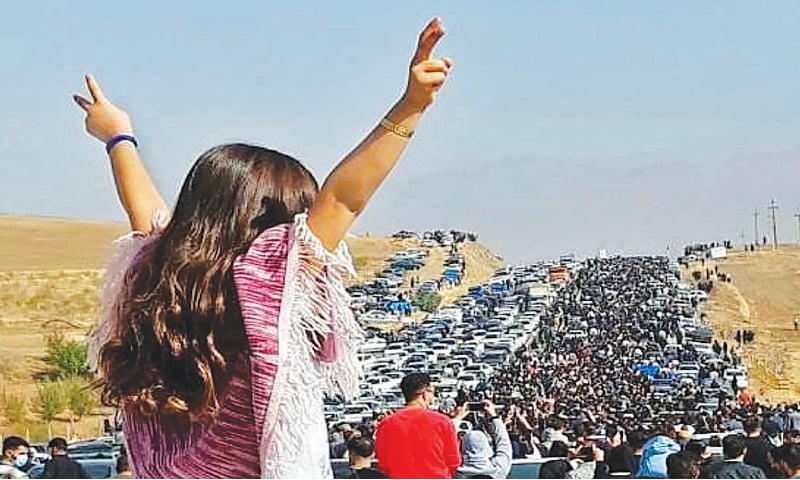
A Victory We Still Have to Defend
What Iranian women have gained in public life since the death of Jina — Mahsa — Amini is real, historic, and dearly won. But no social achievement becomes permanent simply because it now feels normal. The history of the Islamic Republic itself, the experience of the past few years, and examples from elsewhere all point to the same warning: freedom becomes harder to reverse when it moves beyond the street and takes root in law, institutions, the economy, civic networks, and collective memory.
No battle is won in a single night. Every campaign is made up of dozens and hundreds of struggles large and small, advances and retreats, temporary victories and painful defeats, and fields of conflict whose decisive importance we may not even recognize in the moment. Taking one position, however important, does not mean the battle is over; just as losing one front does not always mean final defeat.
But when we are engaged in a long, exhausting, and at times discouraging struggle against a powerful, complex, deeply rooted structure, there is a powerful temptation: once a front is finally taken, to breathe a sigh of relief and assume that what has been gained is now certain and irreversible.
That temptation is understandable. Sometimes we even need that sense of victory in order to continue. The problem begins when we confuse celebrating a victory with the end of the struggle.
In On War, Clausewitz speaks of the “culminating point of victory”: the reality that victory does not necessarily continue producing power indefinitely, and that a point may come when the balance begins to shift again. He explicitly writes that in nearly every war there is a “culminating point of victory.” I do not, of course, mean that a society’s civic struggle should be equated with military war; but the logic of his warning is worth hearing: what has been gained today is not guaranteed tomorrow simply because today it feels real, or even natural.
Sun Tzu, the author of The Art of War, frames the same problem from another angle. Skilled warriors, in his formulation, first place themselves in a position where it is difficult to defeat them and then wait for the opportunity for victory. A little later, he says that a victorious army creates the conditions for victory before entering battle, while an army destined for defeat enters battle first and only afterward hopes to find a way to win. For us, this may have a simple civic translation: before we are forced to defend a freedom again, we should build the mechanisms that can defend it.
Even in the historical collection Maxims of War, which gathers military principles attributed to Napoleon, the discussion of preserving conquests emphasizes that winning is one thing and holding on to the result is another. The important point here is not admiration for a military commander, but that simple distinction we sometimes forget: taking ground and consolidating it are two different stages.
We have had this experience many times. We have celebrated victory too soon, imagined the end of our opponent to be near, assumed him weaker than he was, and postponed planning for the day after victory until victory itself. And every time we have failed, we have looked for someone to blame. There have of course been people to blame, and there still are; but their existence does not remove our own responsibility.
Today, September 13, marks four years since the arrest of Jina — Mahsa — Amini. Three days later, on September 16, 2022, she died. The United Nations Independent International Fact-Finding Mission later concluded that physical violence in detention contributed to her death and that the Iranian state bore responsibility for it. Her tragic death ignited a flame whose fuel, of course, had been accumulating for years and decades.
The “Woman, Life, Freedom” movement did not appear out of nothing overnight. It stood on years of resistance by Iranian women; on protests, many of which have been forgotten; on small and large acts of disobedience that may never have acquired a name; and on the courage of women and men who paid costs that were sometimes unimaginable. Historically, perhaps we cannot state with certainty that it was “the most successful social movement since the revolution,” because there is no clear measure for such a comparison; but without exaggeration, it can be described as one of the broadest and most consequential social movements in contemporary Iran.
Years ago, Asef Bayat used the concept of “social nonmovements” to explain part of this kind of phenomenon in the Middle East: the “collective action of noncollective actors.” He meant people who are not necessarily members of an organization, have no single leader, and may not even know one another, but who in very large numbers repeat similar behaviors in everyday life, with the sum of those dispersed acts capable of creating a new social norm.
Women who enter the street each day without compulsory hijab, a shopkeeper who refuses to expel a customer, a man who refuses to play the role of morality policeman, a family that no longer considers compulsory dress legitimate, and thousands of small decisions like these may have no central command or single leader, but together they shift the boundary of what is possible.
In Weapons of the Weak, James C. Scott also showed the importance of this kind of “everyday resistance”: forms of resistance that are not necessarily marches, uprisings, or manifestos, and that may sometimes be the only avenue available to those who cannot confront power openly. Years later, he explained that overt resistance under repressive governments can at times be impossible or even suicidal, and that resistance therefore moves into subtler, less visible forms.
What we see today on the streets of many Iranian cities belongs to this category, and it is real. The Islamic Republic has not been able to reconstruct the situation that existed before September 2022. Widespread resistance by women, and the political and social cost of repression, have forced the state to retreat from parts of its previous enforcement methods. Human Rights Watch, in its 2026 report, also points to a retreat from some violent hijab-related arrests in major cities; yet the same report stresses that compulsory hijab laws remain in force and that the state has continued to prosecute women, impound vehicles, close businesses, and use digital surveillance.
This distinction is fundamental: retreat is not surrender, and a change in the government’s street-level behavior is not the same thing as a change in its legal structure.
The history of the Islamic Republic itself may offer the closest warning.
Compulsory hijab did not descend on society the day after the revolution in the form of a single, complete law. It developed in stages. In early March 1979, Ruhollah Khomeini declared that women working in government ministries should observe “Islamic standards” in their dress. Large demonstrations by women around March 8 forced the government to step back for a time from immediate blanket enforcement, and some officials even claimed that Khomeini’s remarks had been misunderstood.
Pressure gradually returned. Women who did not wear the kind of covering demanded by the state faced restrictions in some settings; business owners were instructed not to serve women without the prescribed covering; and from 1982 a more intensive campaign to impose dress codes was carried out through patrols and revolutionary committees. Then, in 1983, compulsory hijab entered criminal law, with penalties imposed for women appearing in public places “without Islamic hijab.” What could initially be presented as administrative pressure, advice, or an ideological demand was transformed step by step into a public and criminal rule.
This history matters because it tells us that reversal does not necessarily begin with the announcement of a “day zero.” We do not have to wake up one morning to find all morality-police officers suddenly back on the streets. It may begin at a university, in a few government offices, with the closure of several cafés, the impoundment of cars, denial of a service, a warning to a shop owner, and the gradual normalization of the cost of appearing without hijab.
The years after the Mahsa uprising have, in fact, also shown that the path from 2022 to today has not been linear.
After the initial retreat of law-enforcement forces and the reduced visible presence of the morality police, beginning in spring 2023 the government gradually expanded its use of cameras, text-message warnings, vehicle impoundment, and pressure on businesses. Amnesty International reported orders to impound hundreds of thousands of vehicles, the actual confiscation of tens of thousands, and documented cases in which women were denied public transportation, access to airports, and even banking services.
Then, in spring 2024, the “Noor Plan” began, once again increasing the presence of police and hijab-enforcement personnel in public spaces. Amnesty International reported increased arrests, beatings, harassment, and surveillance of women, while Reuters reported the intensification of the campaign in April 2024, at the same time as military tensions between Iran and Israel. The United Nations Fact-Finding Mission even documented the use of drones to identify women without hijab at the Tehran International Book Fair.
Later, street-level enforcement eased again. The new “Chastity and Hijab” law, which was much harsher than previous rules and provided for financial penalties, imprisonment, employment and education restrictions, and new enforcement tools against women and businesses, was halted on the eve of implementation in December 2024. But suspending its implementation did not mean repealing compulsory hijab laws, and the new law itself has not disappeared from the legal structure.
And now, in the summer and early autumn of 2026, signs of renewed pressure are visible again.
Reports in recent days, based on statements by officials of the Islamic Republic, describe preparations for new university hijab guidelines, the revival of groups tasked with giving women “warnings” about dress, and pressure by hardline members of parliament to implement the suspended law. Gholam-Ali Haddad-Adel has even said explicitly that wartime conditions currently do not allow the government to enter the “hijab front” in the way it would like. That sentence matters in itself: it does not mean that the issue of hijab is over for the government; it suggests that, at least for part of the power structure, full enforcement has been postponed to a more suitable moment.
In recent months there have also been reports of dozens of cafés, restaurants, shops, and gyms being closed over issues related to hijab and “Islamic norms.” At the same time, hardline factions have reportedly increased pressure on Masoud Pezeshkian and even raised the question of his “political incompetence,” although it would not be accurate to attribute all of this pressure solely to hijab. Disagreements over negotiations with the United States, the conduct of the war, the economy, and competition within the conservative camp are also involved.
So my question is this: has the ground Iranian women won at such cost truly become irreversible?
If we look only at the street, an affirmative answer is tempting. We see women walking without compulsory hijab and a generation for whom even imagining a return to the pre-Mahsa situation seems impossible. We may conclude that no government can ever turn the clock back.
I do not trust such certainty.
History is full of freedoms whose holders believed they had become a natural part of the world, only to discover that nothing in politics is natural or eternal.
Afghanistan is an extreme but instructive example. Before the Taliban returned in 2021, women were present in universities, the media, government, parliament, and many professions. After the Taliban returned, much of that legal and social infrastructure was dismantled in a short period, and education, work, freedom of movement, and women’s presence in public life were restricted one after another. Iran is not Afghanistan, and the Islamic Republic is not the Taliban; the comparison is not meant to equate the two. The point is simply a historical warning: experiencing a freedom does not by itself make that freedom secure.
Even established democracies are not immune to reversal. In the United States, a right that had been protected at the federal constitutional level for nearly fifty years under Roe v. Wade was removed from that federal constitutional protection in 2022 by the Dobbs decision. Again, the issue, political system, and circumstances are entirely different. The only common point is that rights not protected by law, institutions, and political balances are not eternal.
And Iran has another example embedded in its own memory: the same process that, after the revolution, transformed hijab from an ideological demand and administrative pressure into a social obligation and then into criminal punishment. If something was built once, step by step, it is not logically possible to dismiss the possibility of an attempt to rebuild it simply because doing so is harder today.
Another reality must also be faced without wishful thinking. The Islamic Republic is today engaged in an exhausting and extremely costly war. Joint U.S.-Israeli attacks began on February 28, 2026; Ali Khamenei and a number of senior military commanders were killed; and Iran’s military and political structures suffered major blows. Yet the government did not collapse. The power structure was rebuilt, new leadership emerged, and the war continues to this day. Reuters in March described this ability of the Islamic Republic’s structures to continue functioning after the killing of major figures as “surprising resilience,” and in September the war still had not ended.
This reality should neither be treated as proof that the Islamic Republic is invincible nor be minimized. The lesson is simpler: an opponent that has repeatedly survived situations many believed would bring about its end must be taken seriously.
I do not even want to make a psychological claim about the government’s future motivations. We do not know exactly what the current leadership will do after the war, and we cannot judge from the outside whether it is acting from some personal “trauma.” But one politically plausible scenario should be taken seriously: a government emerging from a devastating war may turn again to its identity-defining symbols in order to rebuild authority and demonstrate internal control. For an important part of the ruling camp, hijab remains precisely one of those symbols. Statements by officials who call it a “flag” or one of the “foundations of the revolution” show that, for them, the issue is about far more than a headscarf.
On the other side, the future of freedom in Iran can no longer be built on the assumption of foreign intervention.
States act according to their own interests. External pressure, sanctions, human-rights condemnation, or even military operations may influence the behavior of a government, but there is no guarantee that the freedom of the Iranian people is their primary objective. The world’s most powerful military and one of the most advanced armies in the region have now been engaged for months in a direct campaign against the Islamic Republic; despite the enormous damage inflicted on Iran, the war continues and the state structure remains in place. That alone should be a serious lesson for anyone who imagined Iran’s freedom as the inevitable product of an external attack.
The other side of this equation is made up of Iranian forces outside Iran, and here too we must avoid generalization. Thousands of Iranians abroad have paid a price for years, built media organizations, documented human-rights abuses, helped prisoners and their families, and amplified the voices of people who cannot speak freely. That reality cannot and should not be denied.
At the same time, parts of the political space outside Iran have become so consumed by internal warfare that sometimes the cost of opposing one opposition current, at least in public and on social media, appears greater for a critic of the Islamic Republic than the cost of expressing the same opposition to the Islamic Republic itself. Abuse, threats, accusations of treason, and attempts to erase critics are not exercises in democracy, even when practiced by someone opposed to the Islamic Republic.
A march, too, does not acquire meaning simply from the number of participants. A gathering on a Saturday or Sunday in a free city can matter greatly, but if it becomes a repetitive ritual with no clear objective, no understanding of its audience in the host society, no measurable demand, and no idea of what should happen the next day, then its effectiveness must be questioned. Protest is a political tool, and a political tool does not become more powerful merely by being repeated without strategy.
And that same responsibility brings us to the question of the killings in Dey.
What happened in Dey was a catastrophe on a horrifying scale, and precisely for that reason we have a duty to be more obsessive about its numbers than about almost anything else.
The figures still differ greatly. The Iranian government announced 3,117 dead. HRANA later confirmed more than seven thousand victims by name or documentary evidence and said thousands of additional cases remained under investigation. By contrast, TIME, based on conversations with officials in the Ministry of Health and an independent medical count, reported the possibility of more than thirty thousand deaths during the peak days of repression alone. Lack of independent access, communications blackouts, and the scale of the repression still make it difficult to arrive at a definitive figure. But numbers such as one hundred thousand dead, at this point, do not have sufficiently reliable independent support to be stated as fact.
The difference between more than seven thousand confirmed victims and the possibility of thirty thousand victims is not small. But the answer to uncertainty is not to choose the largest number available. We should say clearly what has been confirmed, what is an estimate, what remains under review, and what is only a claim.
This is not merely an ethical or journalistic issue; it is strategic.
If today we turn an unsupported number into our own official narrative simply because it better conveys the scale of the crime, tomorrow the Islamic Republic will not have to answer for the thousands of real deaths. It will only need to find that false claim and present it as evidence that all reports are unreliable. The state’s propaganda machinery has used exactly this mechanism for years.
But there is another concern that must be addressed more cautiously.
We cannot prove that exaggerating the number of victims directly encourages the Islamic Republic to kill more people. There is no evidence for such a causal relationship. But there is serious evidence for a human phenomenon: Paul Slovic and his colleagues have shown that the human mind can experience a form of “psychic numbing” when confronted with very large numbers of victims; our emotional sensitivity does not necessarily increase as the number of victims rises and may sometimes even diminish. What is shocking when attached to one identifiable person may become an abstraction when it becomes thousands or tens of thousands.
That is why I worry about the normalization of very large numbers. If the public sphere today accepts, without evidence, a figure of one hundred thousand dead and learns to live with it, then tomorrow the killing of another two or three thousand people may, within that same numerical frame, appear horrifyingly “small.” We cannot present this as a proven calculation inside the government’s decision-making rooms; but we can take seriously the risk of desensitizing society, the media, and even political actors. When the value of a human life dissolves into very large numbers, all of us lose something.
Every victim is a world. Three thousand people are not “only three thousand” because somewhere a figure of thirty thousand or one hundred thousand has been mentioned.
Truth should be our weapon, not a casualty of our anger.
But even if we set violence aside, we can look at a much simpler tool: economics.
What percentage of people in Iran can go six months without income? How many families can keep a shop — their only source of livelihood — closed in defense of a political principle? How many people can leave the car they use for work in a police impound lot for months? How many students can sustain the same level of open resistance when their ability to continue their education is directly threatened?
Asking this question is not an insult to people’s courage. On the contrary, it means taking the reality of their lives seriously.
If the Islamic Republic once again decides to enforce compulsory hijab on a large scale, it does not need to arrest thousands of women in the streets on the first day. The experience of the past few years has shown that it has cheaper, and perhaps in its view more effective, tools: vehicle impoundment, business closures, fines, denial of public services, employment and university pressure, restrictions on accounts and administrative services, and digital surveillance.
These are not imaginary scenarios. Some have already happened. Amnesty International has documented widespread vehicle impoundments, denial of banking and public services, and pressure on women and their families. The new hardline law also explicitly provides for penalties such as restrictions on employment, education, passports, driving licences, and property.
Now imagine a café owner who knows that serving a woman without hijab may get the business closed. Imagine a driver whose car is his livelihood. Imagine a student whose entire professional future depends on a degree that can be taken away. Imagine an employee whose family depends on that monthly salary.
How many people can choose resistance over subsistence for a long period of time?
We have to be careful not to see society only through the window of our own circle of friends and social-media networks.
Timur Kuran uses the concept of “preference falsification” to explain the surprise of revolutions. Under political and social pressure, people do not necessarily reveal what they truly think. The result is that both governments and their opponents may misjudge the real levels of support, dissatisfaction, fear, and readiness in society. A regime that seemed invincible yesterday may suddenly collapse; but the reverse implication also matters for our analysis: a population that at one historical moment appears unified and ready to bear any cost will not necessarily behave the same way under prolonged economic pressure.
There is no single, homogeneous thing called “the Iranian people.”
There are people with different desires, fears, hopes, and capacities. There are women and men willing to give their lives for freedom, and women and men willing to do the same to preserve the Islamic Republic. Some want rapid and fundamental change; others fear every new episode of chaos. Some are willing to struggle for years, while others simply want their wages paid, their children to go to school, and a little less anxiety at night. Many may not want the Islamic Republic but may also be unwilling to lose their home, livelihood, and family security in a prolonged struggle.
None of them can be removed from the equation and then expected to leave us with an accurate analysis of society.
That is why the more important question may not be, “What are we fighting against?” but rather, “What are we fighting for, and how can we make it endure?”
If freedom of dress is one of the gains of these past few years, we should not postpone protecting it until the day an effort to take it back has already begun. If there is even a small possibility that the government may, under different circumstances, once again begin enforcing compulsory hijab on a broad scale, then we should start thinking today about that day.
Preparation does not necessarily mean building a new, large organization. Perhaps it is better if it does not. A network of prepared lawyers can be created — people who understand hijab-related cases so that in a crisis we do not have to begin by searching for someone with relevant experience. Transparent, auditable funds can be created to support businesses that are sealed because of civic resistance, or to provide emergency resources for women who temporarily lose their car, job, or access to education.
Starting today, we can standardize the documentation of vehicle confiscation, fines, denial of services, dismissal, and business closure, so that each incident does not vanish as a social-media story after a few hours but becomes evidence for legal defense today and accountability tomorrow. Professional networks can be created so that the owner of a café or shop knows that if pressure comes, they are not alone and the cost of resistance will not fall on a single family.
We should even be prepared to talk to parts of the existing structure. Politics is not always a field of black and white. An official, institution, or faction may oppose intensified compulsory hijab not because it believes in women’s freedom, but because it fears protest, worries about economic consequences, seeks political advantage, or wants to preserve its own power. If that disagreement helps prevent broader repression, why should it not be used? A temporary ally does not need to agree with us on everything.
Alongside all of this, we need a network of trust that may be more important than any financial fund or legal network. A network in which asking, “What is the source for this claim?” is not considered betrayal; where someone who fact-checks a number is not accused of whitewashing the government; where disagreement does not become enmity; and where political credibility is not measured by who can shout the loudest.
Such work may not be as exciting as a large rally. It produces no heroic photographs, no short and resonant slogans, and perhaps no one will applaud you for creating a database of volunteer lawyers or an emergency fund. But freedom often endures through precisely this kind of tedious work: when a shop is closed, its owner can still pay the rent; when a woman is arrested, she has a lawyer; when a car is impounded, someone knows exactly which legal route to take; and when the government tries to break people one by one, each person knows there is a network behind them.
The achievements of Iranian women over these past few years should not be diminished. Something major has happened. One of the central symbols of ideological control by the Islamic Republic has been confronted, across a large part of public life, by widespread and everyday disobedience, and the government — at least so far — has not been able to fully reconstruct the previous order. This victory is real, and the price paid for it is real as well.
But precisely because the victory is real, our task cannot be limited to celebrating it.
If freedom means only that fewer officers are standing in the street today, then we still have a fragile freedom. Freedom becomes harder to take back when it takes root in social habit, economic networks, legal protection, civic institutions, collective memory, and ultimately in law. The deeper those roots become, the higher the cost of turning the clock back for any government.
That is why I am not saying that morality-police patrols will certainly return tomorrow in exactly their former form, or that the Islamic Republic will certainly be able to regain what it has lost. Such certainty would be just as unfounded as saying that reversal has become impossible forever. I am speaking about possibility — about something that our own history, the government’s behavior over these past few years, and the statements of officials today tell us we cannot simply ignore.
Perhaps the best way to honor the women who won this ground is not to imagine it as territory that has been won and can now be abandoned. Just as Sun Tzu spoke thousands of years ago about the need to place oneself in a position where defeat is difficult, we too, if this minimum freedom matters to us, should create conditions in which taking it away again is not easy.
Not out of fear, and not out of pessimism, but out of respect for the price paid to reach this point.
Because if one day, through our own lack of foresight and the government’s repressive will, this achievement is lost, what disappears will not merely be the ability to go outside without a headscarf. For a generation that has tasted this freedom, reversal could carry a far larger meaning: the feeling that even after all this resistance, all these lives lost, and all this cost, nothing endures.
And that feeling of futility may be even more devastating than repression itself. An authoritarian government does not survive only through batons and prisons; it succeeds more fully when it convinces its opponents that, in the end, their efforts change nothing. That is precisely why preserving a small freedom can sometimes matter far beyond its apparent size: it proves to society that resistance can produce an enduring result.
So this victory can and should be seen, understood, and even celebrated. But celebrating victory must not keep us from guarding it. This front has been taken, but it has not yet been fortified; it has not yet been secured in law, and powerful forces still openly speak of taking it back.
If this time we are to avoid losing one of our victories, perhaps the real work begins here: turning courage into structure, disobedience into a norm, a norm into a right, and a right into something that any power will find far more costly to take away than it imagines.
Sources and further reading
- Clausewitz, On War — Book VII, Chapter 22: The Culminating Point of Victory
- Sun Tzu, The Art of War — Lionel Giles translation, Project Gutenberg
- Napoleon’s Maxims of War — Project Gutenberg
- UN Independent International Fact-Finding Mission on Iran — Jina Mahsa Amini update
- Asef Bayat — social nonmovements / Life as Politics
- James C. Scott, Weapons of the Weak — Yale University Press
- Human Rights Watch, World Report 2026: Iran
- Encyclopaedia Iranica — Feminist Movements
- Encyclopaedia Iranica — Čādor, iii. In Islamic Persia
- Amnesty International — compulsory veiling, surveillance and mass car confiscations
- Amnesty International — violent enforcement of compulsory veiling / Noor Plan
- Amnesty International — new compulsory veiling law
- Iran International — recent hijab enforcement debate
- Iran International — pressure on Pezeshkian / hardline political moves
- Reuters — U.S.-Israeli strikes on Iran, February 28, 2026
- Reuters — September 2026 Iran war developments
- Reuters — Trump on Iran war, September 11, 2026
- HRANA — Day 48 of the protests / confirmed and pending death cases
- TIME — estimates from Iranian health officials on protest deaths
- Paul Slovic — Psychic Numbing and Genocide
- Timur Kuran — Preference Falsification / Now Out of Never
- Cornell LII — Dobbs v. Jackson Women’s Health Organization
- UN Women — Gender Country Profile: Afghanistan