
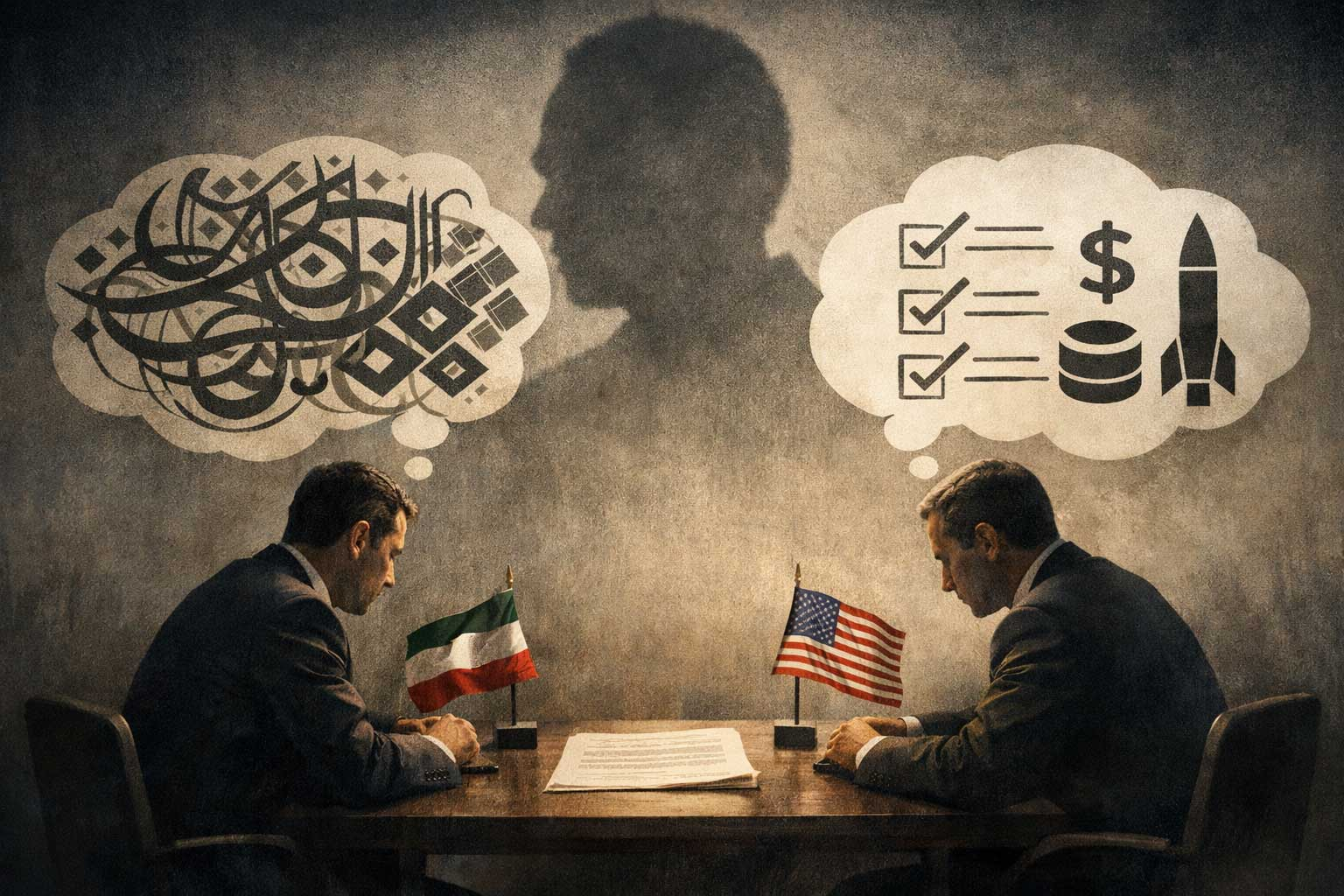
How miscommunication can escalate conflict rather than defuse it
Iran and the United States have entered a kind of relationship. Iran says no negotiation is underway and that it has received only some points from the United States through intermediaries. On the other hand, the United States not only speaks of negotiation but also reports unprecedented and constructive progress and has even announced upgrading the negotiating team to the level of Secretary of State and Vice President. Are all these developments the result of psychological warfare by both sides? Or perhaps both parties are looking at the exact same thing through different lenses and with different meanings.
We do not know precisely what is happening behind the closed doors of politics. What leaks out from the Iran–U.S. negotiations—whether in the form of official statements, media reports, or indirect quotes—is always selective, incomplete, and sometimes contradictory.
Nevertheless, from within this fragmented picture, one important sign is clearly recognizable: a significant portion of this confusion is not merely the result of secrecy or political tactics, but stems from a gap in the mutual understanding of concepts and words.
These days, when contradictory reports about progress or deadlock in the negotiations are published, public attention often focuses on the question: “What happened?” But the more fundamental question is: Have the two sides actually understood each other correctly?
In diplomacy, what is said is not always what is heard. A statement, a proposal, or even silence can produce completely different meanings in the other party’s mind. What one side regards as a “sign of goodwill” may be interpreted by the other side as a “sign of weakness” or a “tactic to buy time.” Here, the issue is not merely a conflict of interests; it is a conflict in the structure of meaning itself.
To understand this situation, one of the most precise frameworks remains Stuart Hall’s “encoding/decoding” model. In his classic 1970s article, Hall showed that messages are never transmitted neutrally. The sender of the message—whether a politician, diplomat, or media outlet—encodes it within a specific framework influenced by cultural assumptions, power relations, and technical constraints. In turn, the receiver decodes the message within their own mental and cultural framework. These two processes do not necessarily lead to the same outcome, even when a common language is used.
Hall distinguishes three types of reading:
Dominant reading, in which the audience understands the message according to the sender’s intention;
Negotiated reading, which is a combination of acceptance and reinterpretation;
Oppositional reading, in which the message is interpreted in a different or even opposite way.
If we extend this framework to diplomacy, we see that many statements and proposals in negotiations are understood at exactly these three different levels.
In relationships like that between Iran and the United States, this gap is far deeper. Every message is interpreted not only in the present moment but also in the shadow of decades of mistrust, contradictory experiences, and competing narratives. In such a context, even if both sides enter the dialogue with the intention of reducing tension, the probability of misunderstanding remains high.
But the complexity does not end there. Even if we assume that the negotiating parties can understand each other’s messages with relative accuracy, another layer intervenes: the media and intermediaries. The media are not merely carriers of messages; they themselves play a role in the production and reproduction of meaning. The choice of words, the omission or highlighting of parts of the message, and the provision of context for interpretation all affect the final meaning.
Here, Marshall McLuhan’s famous idea becomes relevant: “The medium is the message.” McLuhan emphasized that the form in which a message is transmitted affects its meaning. A carefully crafted diplomatic sentence in an official text inevitably loses some of its complexity when turned into a short headline or a tweet. This reduction in complexity, in situations where subtle meanings are vitally important, can lead to misunderstanding.
Even more important is the fact that “media” are not just technical tools. Human intermediaries—from regional mediators to analysts and even translators—are also part of this transmission system. Each of these intermediaries re-encodes the message in its own way. In indirect negotiations, where communication passes through multiple layers of intermediaries, these small distortions can turn into major differences.
For a deeper understanding of this situation, we can also refer to Jürgen Habermas’s theory of “communicative action.” Habermas stresses that real communication occurs only when the parties reach “mutual understanding”—not merely an exchange of information. This understanding requires a degree of shared “horizons of meaning.” Without such commonality, even dialogue can turn into a more complex misunderstanding. He distinguishes between “communicative action” (oriented toward mutual understanding) and “strategic action” (oriented toward achieving success or advantage). In a tense diplomatic environment, strategic action—i.e., the effort to gain leverage—often dominates communicative action, thereby increasing the likelihood of misinterpretation.
The history of diplomacy offers clear examples of the consequences of such gaps. One of the most famous cases is Japan’s reaction to the Potsdam Declaration in 1945. The Japanese Prime Minister used the word “mokusatsu,” which could mean “considering” or “no comment.” However, in the English translation, it was interpreted as “ignoring.” This linguistic misunderstanding, along with other factors, contributed to the decision that led to the atomic bombings of Hiroshima and Nagasaki. Many historians emphasize that this case demonstrates how differences in decoding can have catastrophic consequences—even if it was not the only factor.
Another example is Nikita Khrushchev’s famous 1956 statement: “We will bury you.” In Russian, the phrase was more of an ideological prediction of communism’s historical victory than a direct threat. But in Western translations and media coverage, it was interpreted as a military threat, which helped intensify the atmosphere of the Cold War.
These examples show that diplomatic misunderstandings are often not the result of bad intentions but the product of a mismatch between encoding and decoding frameworks. In such conditions, “failing to see the meaning” can be just as dangerous as “failing to see the information.”
In all this, the media’s role is dual. They can help reduce the gap by providing precise explanations of contexts and semantic differences; or, conversely, they can intensify it through excessive simplification and emphasis on polarized narratives. This requires a kind of professional sensitivity: not only to what was said, but to what might be understood differently.
In today’s world, one of the most important skills—whether for diplomats or journalists—is the ability to “translate between worlds”: between languages, cultures, and systems of thought. If this translation is incorrect, it can change the course of events.
What we are seeing today in the flood of contradictory news may be less a sign of secrecy than a gap in meaning. In such circumstances, focusing solely on “what was said” is not enough. We must ask: “What was understood?” And more importantly: “How was it understood?”
In a world that depends on communication more than ever before, the greatest danger may not be lies, but misunderstanding. If encoding and decoding are misaligned, even the most sincere efforts at negotiation can lead to unintended outcomes. Sometimes what is lost is not the truth itself, but its meaning.