
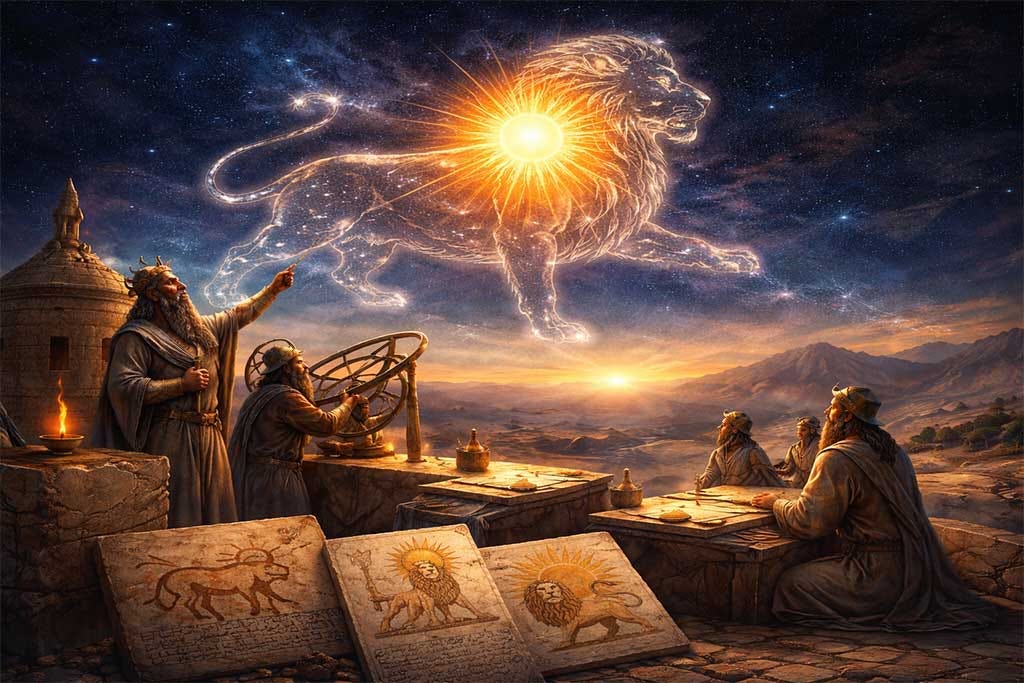
Tracing the Lion and Sun from the Dawn of History
In recent weeks, the “Lion and Sun” emblem has once again become a clamorous subject of debate. Discussions primarily revolve around the political nature of this symbol and its history of use: some view it as an ancient national symbol, while others point to its historical Shīʿite ties. However, this piece is not about the emblem’s political aspects or its function as a national flag. The goal is to explore the roots of this motif at the dawn of history—a time when neither a flag nor a dispute over national identity existed.
Before beginning, an important note: this text is about the “Lion and Sun” in its pure sense, not the version we see today on the Iranian flag with a sword in the lion’s paw. The sword-bearing version is closely linked to the Shīʿite interpretation of this symbol and is attributed to Asadullah al-Ghalib (Ali ibn Abi Talib). Although examples of the Lion and Sun without a sword are seen on earlier coins and miniatures (such as an example from 1460 AD), the expansion and solidification of this motif in governmental emblems accelerated during the Safavid period. However, its standardization as the “official state emblem/national flag” in its modern form was a process that took legal and administrative form in subsequent periods—particularly during the Qajar and Constitutional eras.
The Safavids, by unifying Iran and declaring Shīʿism as the official religion against the Sunni Ottomans, utilized this motif to create national and religious unity, blending it with Shīʿite elements, to the point where the Lion became a symbol of Ali and the sword was placed in his hand. (Of course, the crescent and star symbol itself has pre-Islamic roots and was very common during the Sassanid era. This essay, however, moves past those later layers and seeks the pure “Lion and Sun” motif—a universal symbol that, before any religious or political interpretation, is rooted in the ancient sky and earth.
The Dawn of History in Mesopotamia
Between the two great rivers, the Tigris and the Euphrates, one of the first and most magnificent human civilizations took shape. The Mesopotamian civilization has cast its shadow over our lives to this day: from architecture and art to scientific advancements that became the cornerstones of subsequent civilizations. One of the great achievements of this civilization was the development of astronomy and mathematics. We still use the sexagesimal (base-60) and duodecimal (base-12) systems of the Babylonians (the division of hours and circles), and many foundations of modern astronomy are rooted in the precise observations of the inhabitants of this land.
For the people of Mesopotamia, astronomy was more than just the study of stars. In their early steps toward transitioning from myth to natural science, they held a deep belief in the influence of celestial bodies on the fate of the earth and humanity. Astronomers were often high priests who, atop ziggurats and observation towers, created star charts, made the behaviour of the sky predictable, and linked it to daily life. This belief did not stem from naivety; they saw with their own eyes the effects of the world above on the world below: when the sun reached a certain position, the season of drought arrived; the rising of a specific star heralded the beginning of the rains.
Life in this region was heavily dependent on agriculture and water resources. The flooding of rivers and seasons of drought were life-determining. Ancient man, as Mircea Eliade suggests, whenever faced with something that simultaneously evoked dread, submission, and a sense of being unreachable or insurmountable, considered it “the Sacred” and granted it a high place in their belief structure. The night sky, seasonal drought, or an encounter with a predator like a lion—all of these carried this characteristic.
Seasonal droughts occurred based on a regular cycle. Their peak, accompanied by the region’s scorching heat, coincided exactly with what we today call the “midsummer heat” (Cheleh-ye Tabestan)—the time when the sun, in its apparent motion around the Earth, enters the constellation of Leo (The Lion).
The people of Mesopotamia, who were themselves the founders of the constellations and the twelve-fold division of the Zodiac, knew this constellation by the same name: “The Big Lion” or, more accurately, the “Great Predator.”
The oldest clear record of this name is the MUL.APIN clay tablet series, compiled around 1000 BC but relying on even older traditions (at least from the second millennium BC). In these tablets, the constellation is recorded as MUL UR.GU.LA: “The Big Lion” or “Great Predator” in the Mesopotamian (Sumerian/Akkadian) naming tradition. Researchers at the University of Jena, in the All Skies encyclopedia and in the standard Babylonian astronomical catalogues (such as the works of G. Kurtik, H. Hunger & D. Pingree), consider this identification certain: it is the same as today’s Leo. This means more than a thousand years before the Greeks formulated the twelve-house Zodiac, the Babylonians called this part of the sky the “Lion.”
The reason for naming this constellation the “Big Lion” was not based on imagination alone. In that era—and until a century or two ago in some areas—the people of the region encountered this creature as an external and threatening reality. The species Panthera leo persica (Asiatic Lion or Persian Lion) had a range that included Iraq, Syria, Anatolia, Iran, and even parts of Greece. The famous Assyrian “Lion Hunt” reliefs in Nineveh (7th century BC, now in the British Museum), Herodotus’s reports of lions in Anatolia, and archaeological bone findings all attest to this reality. Hunting a lion was even a ritual to display the power of kings; a symbol of overcoming the wild forces of nature, as mentioned in the Epic of Gilgamesh. The hero who kills the lion effectively brings it down from its sacred status and tames its destructive power.
The Asiatic Lion (Panthera leo persica) is not extinct today; its last stable population remains in India’s Gir Forest. However, this lion was removed from its historical habitats or became locally extinct in Iran and across much of the Middle East. In recent decades, plans to reintroduce the Asiatic Lion to Iran have been proposed, but their sustainable and successful implementation faces serious challenges related to habitat and management.
When the sun enters the house of Leo in its apparent motion and sits within the constellation of the Lion, it signifies a period for the inhabitants of this region where both the great power of the sky and the great dangers of the earth await them. This simultaneity became so significant that it turned into a symbol, a code, and a talisman for critical conditions. The presence of the Sun in the Lion—or the “Lion and Sun”—became established as a symbol of the absolute power of nature and, by extension, a symbol of kingship and heroism. But it always carried a warning: this power could bring great destruction.
Jean Chevalier and Alain Gheerbrant, in the Dictionary of Symbols (Dictionnaire des symboles), write under the entry “Lion”:
“The mighty lion, the king, is a solar and supremely radiant symbol, the king of animals and full of virtues and vices arising from his position. Though he is a manifestation of power, wisdom, and justice, he is simultaneously a sign of the height of pride and egoism. All this makes him a symbol of a father, teacher, or king who shines with such intensity of power that the light of that brilliance blinds him; and since he considers himself a protector, he thus turns into a tyrannical despot.”
When we speak of the positive aspect of this symbol, we see how it becomes an epithet for Krishna, Buddha, Christ, or Ali; and when it manifests in its negative aspect, it is a symbol of masculine power and dominance, and a justice based not on the welfare of the subordinate, but on the exercise of uniform power over all—just as the drought season harms the rich and poor alike.
Thus, the presence of the Lion and Sun during this era, while indicating the importance of the Sun’s position in Leo, does not necessarily imply respect out of affection; rather, it stems from the dread of drought caused by the days of its power and the magnificent capacity to exercise force in this position.
Perhaps this is why Ferdowsi writes in the Shahnameh: “Alas for Iran if it be laid to waste… and become the lair of leopards and lions.”
Similarly, when we refer to ancient myths and motifs, we see the hero—the one who fights for the people—tame the rebellious, powerful, and violent lion in one of his most symbolic acts. This motif is repeated many times from Gilgamesh to the modern era.
Before leaving Babylon, let us recall an important scholarly point: in popular narratives, this constellation is sometimes described as the “House of Shamash” (the god of the sun and justice) or “Nergal” (the god of war and death). However, in the MUL.APIN tablets themselves, the deity associated with UR.GU.LA is listed as Enlil, the primary god of the air, storm, and earth. This scholarly distinction is precise: the Lion in ancient texts was more a symbol of “summer heat and natural power” than a direct assignment to a specific solar deity. Subsequent links with Shamash or Nergal took shape in Hellenistic astrological interpretations.
Thus, the “Celestial Lion” was born from earthly experience—the scorching climate, the real lion, and the cycle of life and death—becoming a millennial symbol that still shines in our sky and lives in our culture.
Ancient Egypt: Where the Celestial Lion Linked with the Life-Giving River
From the scorching plains of Mesopotamia, where the lion symbolized the killing heat and destructive drought, we now go to a land where a magical river renews life every year: Ancient Egypt.
If in Babylon the Lion and Sun were a warning of nature’s destructive power, in the Nile Valley this motif takes on a different colour—a symbol of fertility, rebirth, and the eternal cycle of life. Here, the sun is not only scorching but life-giving, and the lion is not just a predator but a sacred guardian. This change in perspective is rooted in Egypt’s unique climate, where life and death meet in the embrace of the Nile.
The civilization of Ancient Egypt flourished along the Nile thousands of years ago. This river, with its annual floods, fertilized the soil and ensured life. The Egyptians, like the Babylonians, observed the sky with precision, but their astronomy was more intertwined with natural and religious cycles. They believed that stars and planets were manifestations of gods and their behaviour directly affected the Earth. Priest-astronomers in massive temples, such as Karnak or Dendera, created celestial charts and linked cosmic events to daily life. This belief, as described by Mircea Eliade, stemmed from the encounter with “the Sacred”: something that creates both dread and wonder, such as the flooding of the Nile or the brilliance of the sun at the peak of summer.
For the Egyptians, the Sun (personified by the god Ra) was the center of the universe. Ra rose every day from the east, shone in the sky, and fought in the underworld at night to be reborn. The cycle of peak summer heat and the beginning of the Nile flood season is close in the Egyptian agricultural calendar. In practice, rather than taking the “Sun’s entry into Leo” as a direct measure, the Egyptians looked to the heliacal rising of Sirius (Sothis), which in many periods was known as the sign of the approaching flood season.
The flooding of the Nile followed months of drought and enriched the soil; in later symbolic narratives (especially in the Hellenistic-Egyptian Zodiacal tradition), this cycle was also re-read with solar symbolism and the sign of Leo.
Of course, as mentioned, another player also had an important role in this view. The star Sirius was the brightest in the sky during this season, rising in the morning; seeing it heralded the arrival of the Nile flood season. For this reason, the Ancient Egyptians based one of their primary solar calendars on the rising of Sirius.
The symbol of the lion was very prominent in Ancient Egypt (from goddesses like Sekhmet to its role as a guardian), but the “Twelve-Sign Zodiac” and names like Leo in their familiar modern form became popular in Egypt during the Hellenistic-Roman period and blended with native Egyptian traditions. The lion in Egypt, unlike in Babylon, where it was mostly destructive, was often associated with feminine deities such as Sekhmet (lion-headed goddess of war and healing) and Bastet (feline goddess of fertility). This duality—destruction and protection—made the lion an ideal symbol for the sun. In Egyptian reliefs, pharaohs are often shown with a lion’s head, a symbol of solar and royal power descending from the sky to the earth.
One of the most famous examples of Egyptian traditions merging with the Babylonian-Greek Zodiacal system is the “Dendera Zodiac,” a circular relief that was removed from the ceiling of one of the chambers in the Temple of Hathor in Dendera (from the late Ptolemaic/early Roman period) and is now kept in the Louvre. This work presents a collection of constellations and Zodiac signs in pictorial form. It is thus an important document for understanding how the “Twelve-Sign Zodiac” was accepted in Hellenistic-Roman Egypt and reinterpreted in native symbolic language.
In this Zodiac, “Leo/The Lion” is also displayed alongside other signs with a recognizable appearance. But the importance of Dendera lies precisely in the fact that we are not dealing with a “purely astronomical map” in the modern sense, but rather a ritualistic-symbolic representation: a combination of the imported Zodiacal system and Egyptian symbolism. Therefore, if we avoid attributing “precise calendrical function” to every detail of the relief, it can be said that Dendera shows that late-period Egyptians formulated celestial cycles within the framework of their religious narratives and cultural signs—a narrative that later influenced the transfer of ideas to the Mediterranean and then the Islamic world.
In addition to the Zodiac, the Sphinx—a creature with a lion’s body and a human head—adds depth to this interpretation. The Great Sphinx of Giza, attributed to the period of Khafre (around 2550 BC), is a symbol of the pharaoh as the guardian of the sun. (Of course, there is wide disagreement among Egyptologists regarding this.
This link between the sun and the lion in Egypt transformed the “Lion and Sun” motif from a Babylonian symbol of destruction into something more positive: life-giving power. However, the duality was still maintained—the lion could be destructive, like Sekhmet, who brought disease but was pacified by sacrifice. This symbology was later transferred to Greece and Rome, where the Nemean Lion appears in the myth of Heracles and the Hellenistic Zodiac takes shape.
Jean Chevalier and Alain Gheerbrant consider the lion a “solar symbol” which in Egypt is blended with fertility and protection: “The lion, guardian of the gates of the underworld, symbol of the transition from darkness to light—just like the sun that is born every day.” This view turned the Lion and Sun into attributes of divine leaders, such as the pharaoh, who was the “Son of Ra.”
Before leaving the Nile Valley, let us recall a scholarly point: although the Dendera Zodiac is from the Greco-Roman period, academic analyses (such as Gyula Priskin’s article in ENiM) show that the constellation of Leo was also referenced in the Pyramid Texts (around 2400 BC), where the sun is associated with the lion. This distinction is important: Egyptian astronomy was more symbolic than predictive, unlike the Babylonians.
Thus, in Egypt, the “Celestial Lion” was born from the river and the sky—a symbol that turned death into life and became a foundation for subsequent interpretations in Greece and Iran. Now we go from the Nile to the Mediterranean, where this motif blends with Hellenistic philosophy.
Hellenistic Greece and Rome: Where the Celestial Lion Became the Home of the Sun
From the Nile Valley, we now reach the Hellenistic world—a period when Babylonian and Egyptian knowledge blended with Greek philosophy and systematized astrology. Here, in the Alexandria and Athens of the 3rd century BC to the 2nd century AD, astronomy moved beyond being purely religious and calendrical and became a philosophical science. The constellation of Leo, which was previously the “Big Lion” in Babylon and the guardian of the Nile flood in Egypt, now become the “Domicile of the Sun”—the place where the sun is most powerful, brilliant, and an absolute ruler. This change was not only astronomical but semiotic: the lion moved from being a symbol of drought or fertility to a manifestation of leadership, creativity, and individual power.
The Greeks, who took the twelve-house Zodiac from the Babylonians, added their own myths to it. In Greek mythology, the constellation Leo is the Nemean Lion—an invincible monster that Heracles (Hercules) killed in his first of twelve labours. This lion had an impenetrable hide and no weapon could harm it; Heracles strangled it with his bare hands and wore its skin as armour. Zeus took the lion to the sky as a memorial to the hero’s victory. This story, found in classical texts such as Hesiod and Apollodorus, turned the lion into a symbol of unbreakable power and heroic triumph over wild nature.
But in Hellenistic astrology, this myth was combined with astronomical knowledge. Claudius Ptolemy, the 2nd-century AD astronomer and philosopher in Alexandria, systematized the system of planetary houses in his book Tetrabiblos—the most important text of Western astrology. In Book I, Chapter 17, he explains why Leo is the home of the sun:
“Of the twelve signs, the most northern, which are closest to the zenith and produce the most heat and warmth, are Cancer and Leo; these they assigned to the greatest and most powerful celestial bodies, namely the two luminaries (the Sun and the Moon), as their house: Leo, which is masculine, to the Sun, and Cancer, which is feminine, to the Moon.”
Ptolemy justifies this division on natural principles (the sun’s maximum heat in summer) and on Aristotelian philosophy (hot and dry elements). The sun is most powerful in its own house (Leo): a symbol of leadership, creativity, self-confidence, and individual power. This concept was taken from the Babylonians but organized according to Greek logic, in which planets have a “house” (oikos) and act like homeowners in their own houses.
The star Regulus (α Leonis), which Ptolemy calls “a bright star on the heart of the lion,” has the nature of Mars and Jupiter—a combination of martial and royal power. In subsequent astrological traditions, Regulus was counted among the “Royal Stars.” Ptolemy mentions a character for it akin to Mars and Jupiter, associated with kingship, honour, and great success. In the Tetrabiblos, he says: “The bright star on the heart, Regulus, acts like Mars and Jupiter.” This star, called Qalb al-Asad in Persian, was the symbol of the lion’s heart and the center of power—exactly where the sun passes during the height of summer.
In Hellenistic astrology, the sun in Leo is not a symbol of its “exaltation” (the sun’s exaltation is in Aries), but it has the most power in its own house. This system, which later moved to Rome and then the Islamic world, became the foundation of Western astrology. The lion here emerged from the dual Babylonian symbol (destroyer/protector) and the Egyptian symbol (fertilizer) to become a symbol of the “Self” and leadership—traits we see in modern Leo astrology: creative, generous, proud, and royal.
Jean Chevalier and Alain Gheerbrant, in the Dictionary of Symbols, view the lion in the Hellenistic tradition as the “king of animals” and a solar symbol blended with power, wisdom, and justice, but one that can lead to pride and tyranny—the same duality seen in the myth of Heracles: the invincible lion, but ultimately tamed by the hero.
Before leaving the Hellenistic world, let us recall a scholarly point: the division of domiciles was taken from the Babylonians, but Ptolemy justified it with natural philosophy. In the Tetrabiblos, he emphasizes that Leo produces the most heat due to its proximity to the summer solstice, an astronomical-philosophical reason being the sun’s position in the zodiac. This distinction turned astrology from mere divination into a nature-based science.
Thus, in the Hellenistic period, the “Celestial Lion” emerged from myth and philosophy—a symbol of the sun at the peak of its brilliance that became a foundation for subsequent interpretations in Iran and Islam.
Ancient Iran
From the Hellenistic world, we now reach the Iranian plateau. This land not only took this motif from its Babylonian and Egyptian neighbours but blended it with its own ancient beliefs, turning it into a symbol of kingship, divinity, and Farrah (xvarenah). In pre-Islamic Iran, solar motifs were more than just an astronomical image; the sun was considered a symbol of light, justice, and glory/Farrah. One of the most important deities of this period, Mithra (Mehr), who was the guardian of covenants and oaths, was envisioned as the light before sunrise or after sunset.
Ancient Iranian civilization, rooted in early Iranian beliefs, saw the sky as a mirror of the earthly world. Astronomy and astrology, borrowed from the Babylonians, were blended with Zoroastrian and Mithraic philosophy.
The sun holds a central place in the pre-Islamic Iranian worldview, linked with concepts of light, truth, and Farrah; and Mithra, as the god of covenants and light, plays a prominent role in this system.
Mithra, a pre-Zoroastrian deity who later became a companion to Ahura Mazda, was the embodiment of light, truth, and cosmic order. The Encyclopedia Iranica explains that xvarenah (divine glory or brilliance) is associated with the sun and Mithra. It would descend upon kings and heroes like a radiant sun, but it was a concept that, as Dr. Jaleh Amouzgar says, was accompanied by individual duty. In other words, no hero or king could reach power without Farrah, but it was not a gift given once and for all. Farrah was earned and had to be maintained; if the king strayed from the path of Good Thoughts, Good Words, and Good Deeds, Farrah would depart from him.
In Iranian astronomy, as in the Babylonian tradition, the constellation of Leo was the house of the sun. Pahlavi texts like the Bundahishn (The Book of Genesis) and Sassanid translations of Greek works confirm this. In the Bundahishn (Chapter 5), the houses of the planets are described, and the sun is in Leo, a symbol of maximum and royal power. The lion, seen in Achaemenid reliefs such as those at Persepolis, was a symbol of kingship and triumph over wild forces. For example, in the Apadana of Persepolis, a lion is shown attacking a bull (a symbol of the moon). This scene has been interpreted in various ways in research: from seasonal/annual readings linked to Nowruz rituals to cosmic readings of the sun/moon or royal power.
Interestingly, in the Sassanid-era astronomical tradition, there is a “dark version” of the sun that appears during eclipses and in the global battle between good and evil, covering the sun’s face for a few hours.
The “winged disc” motif is prominent in Achaemenid art; while it is sometimes popularly attributed to the “Faravahar,” Iranian studies usually distinguish between the winged disc as a royal/religious symbol and the concepts of fravashi/farrah. This motif has roots in the winged sun of Egypt and Babylon. The Faravahar is not only a symbol of the guardian spirit but is also linked with the sun and Mithra. Achaemenid kings like Darius showed the Faravahar above their heads to indicate that divine glory and Farrah had descended upon them. This symbol, sometimes combined with the lion (as in later Seljuk motifs), conveys the duality of power and protection: the brilliant sun and the guardian lion.
Mithraism, which originated from early Iranian beliefs, took these symbols to their peak. Mithra, the deity presiding over covenants and the precursor of the sun, was associated with the lion in myths. In Roman Mithraism, which travelled from Iran to Rome, the initiation stages included Leo (Lion). Kaveh Farrokh explains: “The ancient Iranian cult of Mithraism, from which the sun motif is derived, had a tradition spanning thousands of years… the fourth stage (Leo), the fifth stage (Perses or Persian), and the sixth stage (Heliodromus or Sun-runner) show strong mythological links between Roman Mithraism and ancient Iranian mythology.”
These symbols continued until the end of the Mithraic era. Mithra remained as a yazata (divinity) within Zoroastrianism, and his symbols—the lion as a guardian and the sun as the source and symbol of Farrah—persisted in the culture. Jean Chevalier and Alain Gheerbrant view the lion as a “solar symbol,” which in Iran is blended with Mithra and kingship.
Before leaving the Iranian plateau, let us recall a scholarly point: although the Lion and Sun became popular as a national symbol from the 12th century AD (Encyclopedia Iranica, “Lion and Sun”), its roots predate the Achaemenids—not a Safavid invention, but a continuation of the Babylonian-Iranian tradition.
The Islamic Era: From the Seljuks to the Safavids – Where the Celestial Lion Became a National and Religious Symbol
We now reach the Islamic period—an era in which this motif not only survived but also transformed from an astronomical and decorative motif into a governmental and religious symbol. In the Islamic Middle Ages, with the arrival of the Turks and Seljuks, the Lion and Sun moved from cosmology into art, coins, and banners. In the Safavid era, with the declaration of Shīʿism as the official religion, it took on a fresh meaning: a symbol of state and religion, positioned against the Ottoman crescent moon.
After the Arab conquest of Iran in the 7th century AD, ancient symbols such as the Lion and the Sun did not disappear; they were recreated within the framework of Islamic art. In the early Islamic era, this motif was primarily decorative, appearing on metalwork, tiles, miniatures, and coins. Shapur Shahbazi in Encyclopedia Iranica explains that the Lion and Sun was a combination of Iranian, Arab, Turkic, and Mongol traditions and became a popular symbol from the 12th century AD (6th century AH).
The main turning point was the Seljuk period (11th–12th centuries AD). The Seljuks, of Turkic nomadic origin, used the lion as a symbol of familial and royal power on their banners. But the addition of the sun, rooted in its astronomical relationship with the sign of Leo (the house of the sun), completed this motif. The oldest known examples are from the coins of the Seljuks of Rum (Anatolian Seljuks) in the 13th century AD; for example, those of Kaykhusraw II (reigned 1237–1246 AD), which feature the Lion and Sun. This motif, initially astronomical, gradually became popular as a symbol of power and glory in Islamic art, without specific religious weight, but linked to earlier Iranian traditions.
In the post-Mongol and Timurid periods (14th–15th centuries AD), the Lion and Sun continued to appear on artworks and occasionally on banners. Still, it was not yet an official state symbol. Timurid miniatures (such as one from 1460 AD) show the Lion and Sun without a sword.
The great transformation occurred during the Safavid period (1501–1722 AD). The Safavids, who unified Iran after centuries and declared Twelver Shīʿism the official religion, needed a symbol that represented both national-Iranian identity and a religious distinction from the Sunni Ottomans (who used the crescent moon). The Lion and Sun was chosen for this role. Afsaneh Najmabadi notes that during the Safavid era, this emblem represented two pillars of society: “State” (the lion as earthly power) and “Religion” (the sun as the light of faith and divine legitimacy).
Shapur Shahbazi emphasizes that the Safavids interpreted this motif, inspired by Ferdowsi’s Shahnameh: the “Sun of the Iranians” versus the “Moon of the Turanians/Turks” or the “Moon of the West” (Rome/Ottomans). Thus, the Lion and Sun stood in opposition to the Ottoman crescent. By the time of Shah Abbas the Great, the Lion and Sun had become a common sign on banners, coins, and artworks. Adam Olearius, a European traveller who came to Iran in 1636, wrote: “Today the Turks have the crescent moon as their sign and the Persians have the sun, which is often placed above a lion.”
During this period, the lion gradually became associated with Asadullah al-Ghalib (Ali ibn Abi Talib). The sun was a symbol of Jamshid (the mythical king of Iran) or divine light. Safavid kings saw themselves as “King and Holy Man”: a combination of Iranian kingship and Shīʿite Wilayah. The sword in the lion’s paw (Zulfiqar, the famous sword of Ali) also appeared in some versions, though in many early Safavid banners, the lion was without a sword. This dual interpretation turned the symbol into a tool for national and religious unity.
By the end of the Safavid era, the Lion and Sun had transformed from an astronomical-decorative motif into an official governmental and religious symbol. This foundation continued through the Afsharid, Zand, and Qajar periods, becoming the official national flag of Iran in the 19th century.
Afterword
This is the story, documented by credible sources, of the evolution of an astronomical symbol. A symbol that took shape in an attempt to interpret the realities of life and its dangers in Mesopotamia appeared in different forms across various cultures and eventually became one of Iran’s national symbols from the Safavid era.
Given this, is the Lion and Sun an Iranian symbol? The answer depends on how we define “Iran.” The roots of this symbol and its interpretations date back to before the formation of Ancient Iran, and its tracks can be found in various cultures from China to Egypt. However, Iranians developed their own interpretation of this symbol and, over nearly three thousand years, crafted a new concept from it.
From this perspective, the Lion and Sun is a universal symbol that Iranians have developed a specific interpretation of.
In this interpretation, however, the presence of the lion, rather than symbolizing pure bravery, is a warning of its destructive power. A power that must be tamed so it can serve procreation and security; if untamed, it can become a sign of the wild and destructive nature of the environment.
This symbol of kingship is simultaneously a reminder of Farrah—that which is earned not by the person’s essence but through their effort, as Ferdowsi says in the famous story of Kaveh:
“Faridun the blessed was not an angel | He was not fashioned of musk and amber | Through justice and generosity he found this goodness | Act with justice and generosity, and thou art Faridun.”
And of course, the history of the Shahnameh is full of kings over whom the lion’s trait of pride prevailed, and they lost their Farrah.