
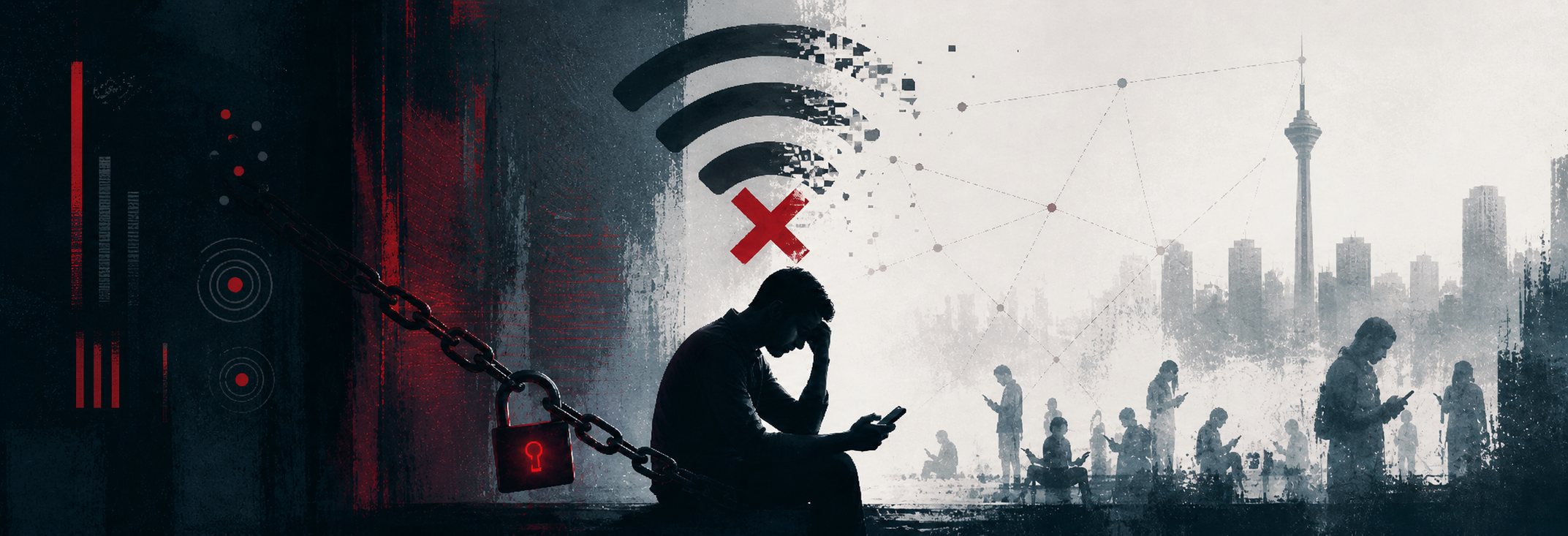
Can the 60-day internet blackout in Iran be analyzed within the framework of crimes against humanity?
A society cut off from the global internet for weeks experiences more than a temporary inconvenience. Rather than a brief disruption, a prolonged blackout fundamentally alters daily life. In this context, the problem extends beyond inaccessible social networks or unstable messaging applications. Students are separated from classes, academic resources, and professors; small businesses lose contact with customers; patients are deprived of medical information and services; journalists are cut off from sources and witnesses; migrant families are isolated from relatives within the country; and society as a whole is denied visibility, access to justice, and the ability to document violence.
The internet has become integral to contemporary life, no longer occupying a peripheral role. Digital connectivity, particularly in societies facing political crises, war, repression, sanctions, or mass migration, serves as a critical conduit for education, health, economic activity, information, family connections, political participation, and collective memory. Disrupting this connectivity—especially when the disruption is prolonged, intentional, widespread, and non-transparent—constitutes more than the closure of a few websites; it deprives society of a foundational infrastructure essential to modern existence.
In Iran in 2026, this image is no longer purely hypothetical. Reuters reported on April 28, 2026, that a new wave of internet blackouts began after February 28 and that by late April, most people in Iran had been without normal access to the global web for more than 60 days. Cloudflare Radar also reported that on February 28, coinciding with the intensification of military attacks, Iran’s internet traffic dropped to less than 1% of its previous level, from around 10:30 local time. NetBlocks similarly reported that during the same period, Iran’s blackout had entered its 63rd day.
However, precision is necessary from the outset. What has occurred in Iran is not simply a straightforward and uniform “complete shutdown.” Reports indicate a combination of near-complete global internet cuts, severe disruptions, filtering, access restrictions, reliance on circumvention tools, the national information network, and tiered access. There have also been reports of arrests or prosecutions of those using alternative routes, such as Starlink equipment, in some cases resulting in heavy sentences.
Accordingly, this article does not address issues such as slow internet or limited platform access. The central question is whether severe, prolonged, intentional, repressive, and widespread shutdown or restriction of the global internet should be regarded solely as an extreme form of censorship, or whether, in the contemporary context, such shutdowns may constitute a fundamental deprivation that, under specific conditions, warrants analysis within the framework of international criminal law and the concept of ‘crimes against humanity.’
A cautious position is adopted: Internet shutdowns are not, in themselves or in all circumstances, classified as crimes against humanity.
Such a title does not appear in Article 7 of the Rome Statute, and international criminal law has not yet defined “internet shutdown” as an independent crime. However, if an internet shutdown is prolonged, intentional, widespread or targeted; applied against a civilian population; carried out in the context of a state or organizational policy; linked to political repression, discrimination, or social control; and results in severe deprivation of fundamental rights or severe suffering, it can be examined as a tool or component in the realization of existing categories of crimes against humanity, particularly “persecution” or “other inhumane acts.”
The basis of this analysis is Article 7 of the Rome Statute and the International Criminal Court’s Elements of Crimes document.
1. The Internet: From Communication Tool to Contemporary Life Infrastructure
In the first decades of the internet’s expansion, it could largely be viewed as a communication technology—an instrument for email, web browsing, entertainment, or faster access to news. But today, this definition is insufficient. The internet is now part of the infrastructure of social life: education, work, health, banking, commerce, family communication, public services, journalism, justice-seeking, political participation, and even collective memory depend on it.
The International Telecommunication Union’s Facts and Figures 2025 estimates that about six billion people—nearly three-quarters of the world’s population—were online in 2025; nevertheless, 2.2 billion people remain offline. The same report emphasizes that the digital divide is not limited to connectivity; quality, speed, reliability, cost, and digital skills also determine who truly benefits from the digital world.
The World Bank, in its digital development reports, regards digital connectivity as part of the path to development, public services, economic growth, and new opportunities. But these same sources warn that lack of access, weak infrastructure, skill inequality, and urban-rural divides can turn digital access from an engine of development into a mechanism for reproducing inequality.
Consequently, when a government cuts off or severely restricts internet access, it does not simply close a single communication channel. Rather, it severs a chain of opportunities, including learning, employment, commerce, social contact, access to assistance, news reporting, documentation, protest, self-defence, and connection with the global community. At this point, internet blackouts transcend the realm of ‘technical disruption’ or ‘media censorship’ and become a structural concern.
2. Iran: From Internet Blackout to Structural Deprivation
The Iranian case in 2026 is particularly significant because the internet blackout was neither brief nor confined to a single location. Reuters reported that most Iranians had been without normal access to the global web for more than 60 days, and only a small group with advanced or expensive tools had managed to bypass some restrictions. AP also reported on May 1, 2026, that the prolonged internet blackout severely damaged businesses dependent on platforms such as Instagram and WhatsApp and placed Iran’s digital economy in a more fragile position.
In this case, three levels must be distinguished.
First, the technical reality of the blackout. Cloudflare data show that on February 28, 2026, Iran’s internet traffic fell to less than 1% of its previous level. NetBlocks also reported that the blackout has persisted for more than 60 days. These data indicate that the issue was not merely the filtering of a few platforms but a deep disruption to Iran’s connection to the global internet.
Second, the social reality of the blackout. AP and Reuters have reported that the internet shutdown directly affected small businesses, online sellers, freelancers, platform economy workers, and citizens whose communication, work, or income depends on the internet. Reuters has also cited estimates of tens of millions of dollars in daily damage but stressed that it had not independently verified these figures. Nevertheless, field reports from Iran describe a widespread wave of unemployment, business closures, and serious economic problems for people resulting from this cutoff.
Third, the political reality of the blackout. This shutdown occurred amid protests, a political crisis, military tension, and governmental control. Reports from Access Now and the KeepItOn coalition show that internet shutdowns worldwide—especially during periods of protest, elections, war, and crisis—have become a recurring tool for controlling information and limiting collective action. The coalition recorded 313 shutdowns in 52 countries in its 2025 annual report.
In the case of Iran, the problem extends beyond the lack of access to specific applications. Rather, an entire society, at a critical historical moment, has been disconnected from a fundamental infrastructure of modern life.
3. Class-Based Internet and Tiered Digital Citizenship
One of the most important dimensions of the Iranian case is the issue of class-based access. Reuters reported that the Iranian government approved a plan called “Internet Pro” for some businesses to reduce the economic pressure from the blackout. But this very action, if it leads to selective and conditional access, can institutionalize digital inequality even further.
Le Monde, in an April 2026 report, wrote that access to the internet in Iran has shifted from a public right to a privilege granted by the government to specific groups—including certain professions, individuals close to power, and those with special or whitelisted access.
This point is very important socially. If the official justification for the restriction is national security and crisis conditions, granting special access to selected groups raises a serious question: If global connectivity is inherently a security threat, why is it permitted for some groups? And if it can be managed for some groups through supervisory or licensing mechanisms, why must the majority of society be collectively deprived of it?
The primary risk is not limited to a complete internet shutdown. A more significant concern is the normalization of selective global internet access, where only a small segment of the population is permitted connectivity while the majority faces prohibition or restriction. In this context, access to knowledge, markets, communication, news, language, employment opportunities, and international connections is allocated based on political, economic, occupational, or security status, rather than equal citizenship rights.
This situation can be called “tiered digital citizenship”: an order in which some citizens are connected to the world while others are kept in a closed, slow, censored, and surveillable network. Such an order turns the digital divide from a technical issue into a form of social engineering.
4. The Digital Divide: From Inequality of Access to Social Rupture
The digital divide is not merely about some groups having the internet and others not. New literature in this field shows that the digital divide is multi-layered: a divide in access, a divide in the quality and speed of connection, a divide in usage skills, a divide in freedom of use, and a divide in the outcomes that technology use creates for education, work, income, and social participation.
The importance of Jan van Dijk’s theory of the digital divide in this discussion is that he does not limit digital access to infrastructure or physical connection alone. In van Dijk’s model, digital access is a multi-stage process: first, motivation, trust, and willingness to use must exist; then material access to tools and connection must be provided; after that, the necessary skills for use must be formed; and finally, the individual must be able to use the technology in an effective, diverse, and meaningful way. Van Dijk, in his famous article on the achievements and shortcomings of digital divide research, formulates these four levels as “motivational, physical, skills, and usage access” and shows that even after the expansion of physical access, gaps in skills and usage can persist or deepen.
From this perspective, the digital divide does not end with “being connected.” If people are deprived of the global internet for weeks or months, they do not merely lose their connection; they also lose part of their skills, usage habits, professional networks, access to new tools, and competitive ability. Research by van Deursen and van Dijk also shows that “access” to the internet must be understood in a multifaceted way: motivation, tools, skills, and the possibility of meaningful use all play a role in truly benefiting from the internet.
In a society simultaneously facing political repression, surveillance, filtering, and security risks, this divide acquires a deeper layer. Fear of surveillance, the risk of punishment, insecurity in using communication tools, the high cost of circumventing restrictions, and digital self-censorship can weaken motivation and the possibility of free internet use, even after apparent restoration of connectivity. Therefore, society does not necessarily return to its previous point after reconnection. Groups that had special access, financial resources, expensive tools, technical skills, or institutional connections during the blackout remain ahead, while deprived groups return to the network with delay, distrust, and more eroded skills.
In Iran, when the government imposes internet restrictions, the digital divide is no longer merely the result of poverty, geography, or weak infrastructure. This divide results from a political decision. In such conditions, society is divided into several communication worlds: a group that still has access to the global internet, scientific resources, foreign markets, independent media, and communication tools; and a majority that remains in a limited, domestic, and controlled network.
The consequence of this situation can be generational. A student deprived of educational resources, online classes, or language-learning tools for two months does not merely lose a few weeks of lessons; they may fall behind in educational competition and future opportunities. A university student not connected to articles, software, professors, classes, or academic platforms falls behind in knowledge production and entry into the global scientific community. A small business that loses customers, advertising, payments, and connections for two months may never return to its previous point. In an era when web-based tools, including artificial intelligence tools, are changing the methods of education, work, and knowledge production at an unprecedented speed, prolonged deprivation of connectivity can create a gap beyond today: a gap in a society’s ability to be present in the future.
Thus, a prolonged internet shutdown not only disrupts current conditions but also has significant implications for the future.
5. Economic and Livelihood Consequences
The internet blackout in Iran, according to AP reports, has severely pressured the digital economy and businesses dependent on platforms. AP reported that many online sellers and entrepreneurs, especially those using Instagram and WhatsApp for sales, advertising, and customer contact, have lost income or been severely damaged.
Reuters also reported economic estimates of tens of millions of dollars in daily damage. In this report, a daily figure of 30 to 40 million dollars was cited, with higher figures when indirect effects were included, but Reuters itself emphasized that it had not independently verified these estimates.
Analytically, even if the exact damage figure is debatable, the direction of the effect is clear: prolonged internet shutdowns disrupt online sales, separate freelancers from employers, slow or render digital payments and services impossible, disable online advertising, destroy customer trust, and increase the cost of circumventing restrictions. The Internet Society, in its policy report on internet shutdowns, emphasizes that shutdowns have wide economic, human rights, and technical consequences and weaken user trust, online services, local economies, and the credibility of countries’ digital environments.
In an economy already strained by inflation, sanctions, unemployment, and instability, an internet blackout delivers a compounded impact. It reduces immediate income and simultaneously obstructs alternative avenues for employment, education, commerce, and global engagement.
6. Educational, Cultural, and Family Communication Consequences
Education today is largely intertwined with digital connectivity—even in societies where in-person education remains central. Educational resources, articles, online classes, educational videos, communication with professors, specialized software, and international exams all require reliable connectivity. UNESCO, in its digital education programs, emphasizes the role of technology in educational policy-making, digital learning, skill development, and educational justice.
In Iran, the educational impact of the blackout cannot be measured merely by the number of lost online classes. Students and pupils are separated from global resources, language learning, scientific platforms, software, university connections, and international opportunities. This deprivation is more severe for groups that previously lacked alternative resources: students in deprived areas, students without special access, restricted women and youth, and those whose hope lay in remote work or study.
On the other hand, for a society with a large migrant and diaspora population, the internet is not merely a news tool; it is the thread of family connection. When the internet is cut off, families abroad remain uninformed about their loved ones, and citizens at home are separated from their support networks. In times of war, protest, arrest, repression, or crisis, this lack of information itself becomes an independent form of suffering.
7. Psychological and Social Consequences: Anxiety of Being Uninformed
Internet shutdown does not only cause economic or educational damage. Prolonged blackout can intensify anxiety, feelings of isolation, helplessness, lack of information, decreased social trust, and the spread of rumours. When people cannot verify news, contact family, learn about the situation in their city or country, or request help, the social space becomes more psychologically and informationally insecure.
Direct, systematic data on the psychological consequences of the internet blackout in Iran remain scarce and require independent research. However, similar experiences, including prolonged blackouts in Kashmir and India, have shown that cutting communication in the context of political crisis and social restriction can increase psychological pressure, loneliness, distrust, and social harm. This comparison should not be oversimplified, but it shows that internet blackouts must also be examined alongside mental health and social security.
In the case of Iran, for a more investigative version of the article, documented citizen testimonies, interviews with businesses, psychological data, human rights organization reports, and narratives from migrant families need to be collected. Without these data, one must speak cautiously about the intensity and extent of psychological effects. But citizen observations and narratives indicate that such effects have occurred and impacted society.
8. Human Rights in the Pre-Internet Era and the Question of Legal Reconsideration
Before discussing crimes against humanity, the level of human rights must be clarified. Internet shutdowns usually do not violate a single right; they simultaneously disrupt a network of rights: freedom of expression, access to information, right to education, right to work, right to health, right to assembly and organization, political participation, family connection, and equal access to services.
The report of the UN High Commissioner for Human Rights on internet shutdowns examines this phenomenon from the perspective of trends, causes, legal consequences, and effects on a range of human rights. This report considers shutdowns particularly dangerous in situations where people need the internet more than ever for communication, information, security, relief, and public oversight.
But a more fundamental question also arises here. Many constitutions, human rights documents, and rules of international criminal law were written in a world where the internet either did not exist or did not occupy the place it does today in social life. Iran’s constitution was written in 1979 and revised in 1989—before the internet, social networks, platform economy, online education, digital services, and artificial intelligence tools became the infrastructure of daily life. Even many of the main international human rights documents were drafted in the pre-digital era.
This reality does not render those documents invalid. On the contrary, the strength of human rights lies in their general principles, which can be interpreted in light of new conditions. But today’s question is whether existing legal frameworks are sufficient to understand digital deprivation, or whether they need to be reconsidered and developed.
International law in recent decades has shown that the concept of fundamental rights can expand as human living conditions change. For example, the UN General Assembly in 2010 recognized the right to safe drinking water and sanitation as a human right essential for the full enjoyment of life and other rights. In 2022, the UN General Assembly recognized the right to a clean, healthy, and sustainable environment as a human right. These developments show that human rights are not a closed list of past needs but a dynamic response to conditions that shape the possibility of human life.
From this perspective, the question about the internet must be taken seriously. If we consider intentional and prolonged deprivation of access to safe water, food, health, or a healthy environment as a serious violation of human rights, should intentional and prolonged deprivation of information, communication, education, work, and social participation—in a world where these possibilities pass through the internet—not be reconsidered at a level close to fundamental rights? The current legal answer is not yet that “internet” is independently and absolutely equivalent to water or food. But it can be said that free, safe, sustainable, and non-discriminatory access to the internet has today become one of the practical conditions for the enjoyment of many fundamental rights.
This is the point at which law must align with the reality of contemporary life. Just as the right to safe water emerged from a new understanding of dignity, health, and human life, the right to access information and digital connectivity may gradually come to the fore in future legal discussions. Especially in a world where falling behind the flow of information, knowledge, and technology can lead to educational, economic, and even civilizational backwardness, digital deprivation is no longer a secondary issue.
9. Iran’s Domestic Law: Is Internet Blackout Compatible with the Constitution?
Even if we set aside the framework of international law and examine the issue solely from the perspective of Iran’s domestic law, a prolonged, widespread, and non-transparent internet shutdown raises serious constitutional questions. The Constitution of the Islamic Republic of Iran does not explicitly recognize a right called “the right to internet access,” which is natural, since the constitution was written before the emergence of the public internet. But several of its principles can provide an intra-governmental basis for arguing against a widespread internet blackout.
Article 9 of the Constitution stipulates that no authority has the right, in the name of preserving the country’s independence and territorial integrity, to deprive people of legitimate freedoms “even by enacting laws and regulations.” This principle is legally important because it shows that even the argument of national security cannot provide an absolute license for widespread deprivation of legitimate freedoms.
Article 25 also prohibits inspection or non-delivery of letters, recording and disclosure of conversations, disclosure of telecommunications, censorship, non-transmission, and any form of investigation except by law. Although this principle was written in the era of letters, telephones, telegraphs, and telexes, its protective logic concerns the immunity of communications and the prohibition of arbitrary disruption in message delivery—a logic that, with interpretive caution, can be extended to digital communications in the present era.
Furthermore, Article 3 of the Constitution obliges the government to raise public awareness through the press, mass media, and “other means” to extend education, remove unjust discrimination, and ensure political and social freedoms within the limits of the law. In today’s society, the internet is one of the most important examples of those “other means” for public awareness, education, social communication, and civic participation. Also, Articles 24, 20, 28, and 30 of the Constitution—respectively on freedom of expression in the press, equal enjoyment of human and social rights, the right to employment, and the right to education—show that internet shutdown can affect not merely the restriction of one technical tool but a set of fundamental rights. The text of the Constitution is available on the websites of the Guardian Council and the Majlis Research Center.
At the level of ordinary laws, Article 2 of the Law on Publication and Free Access to Information recognizes the right of every Iranian person to access public information, except where prohibited by law. This law does not directly create a “right to the internet,” but it recognizes access to public information as a citizenship right—a right that in today’s world is severely limited without a free and effective internet connection.
Therefore, within the framework of Iran’s domestic law as well, the issue is not that the government can never impose technical or security restrictions under special conditions. The issue is that such a restriction must be based on clear law, necessary, proportionate, limited in time, non-discriminatory, subject to oversight, and subject to objection. Prolonged, widespread, disproportionate, and non-transparent global internet blackout—especially if applied without a specific order, without public announcement of legal basis, without effective judicial oversight, and without avenues for citizens to object—not only conflicts with international human rights standards but also with the spirit and logic of several principles of Iran’s Constitution and domestic laws on access to information.
In summary, restrictions should be exceptional rather than routine, targeted rather than collective, limited in duration rather than prolonged, transparent rather than concealed, and subject to challenge rather than absolute.
10. Can Widespread Internet Shutdown Be Analyzed Within the Framework of Crimes Against Humanity?
Article 7 of the Rome Statute defines crimes against humanity as a set of acts committed “as part of a widespread or systematic attack directed against any civilian population, with knowledge of the attack.” These acts include murder, extermination, enslavement, deportation, imprisonment, torture, sexual violence, persecution, enforced disappearance, apartheid, and “other inhumane acts.”
Therefore, the first point is this: Internet shutdown does not appear in Article 7 as an independent title. This article should not, and cannot, claim that every internet shutdown is, in itself, a crime against humanity. The more precise question is: Can a prolonged, intentional, widespread, or targeted internet blackout, under specific conditions, serve as a tool or component in the realization of one of the acts listed in Article 7?
Two legal paths warrant closer examination: persecution and other inhumane acts.
11. First Path: Persecution
In international criminal law, persecution arises when a group is intentionally deprived of fundamental rights on grounds of political, ethnic, national, religious, cultural, gender, or similar identity. The International Criminal Court’s Elements of Crimes document also emphasizes, for the crime of persecution, severe deprivation of fundamental rights, targeting based on group or collective identity, and connection to a widespread or systematic attack against a civilian population.
In this framework, an internet shutdown can be considered persecution when three important conditions are met.
First, it must be shown that the internet blackout has led to severe deprivation of fundamental rights. For example, if people are widely deprived of education, work, health, family communication, information, political participation, and justice-seeking, we are no longer dealing with everyday discomfort or a simple technical problem.
Second, it must be shown that this deprivation was targeted or discriminatory. For instance, if the shutdown is applied to repress protesters, silence specific areas, deprive political groups, prevent documentation of violence, or control minorities, the element of persecution becomes more examinable.
Third, the relationship of the shutdown to state or organizational policy must be proven. In international criminal law, it is not enough for a harmful action to have occurred; it must be shown that this action was part of a widespread or systematic attack against a civilian population and in line with a specific policy.
In the case of Iran, available data show that the blackout occurred amid protests, a political crisis, and military tension, and that access to the global internet for the majority of people was disrupted. But to turn this analysis into a complete legal claim, the link between the governmental decision, the political goal, the affected groups, and the severity of the deprivation must be supported by more precise documentation.
12. Second Path: Other Inhumane Acts
Article 7 of the Rome Statute also speaks of “other inhumane acts of a similar character”; acts that intentionally cause great suffering or serious injury to body or to mental or physical health. The Elements of Crimes document also emphasizes the same criteria: severity, suffering or injury, and the perpetrator’s awareness of the attack’s context.
The difficult question is: Can a sixty-day internet shutdown reach this level?
The cautious answer is: Not in all cases. But under specific conditions, it is examinable. If internet shutdown causes people to be unable to access health services, security warnings, family communication, education, work, vital information, the possibility of documenting violence, or ways to seek help; if this deprivation is widespread, prolonged, intentional, and irreparable; and if its effects on people’s mental health, livelihood, security, and social life are documented, it can be examined whether it has reached the level of “great suffering” or “serious injury to mental health.”
Here, hasty generalization must be avoided. It can be said that some researchers in communications, digital rights, and human rights consider prolonged internet shutdowns to have serious social, economic, and psychological effects; but for a criminal law claim about “great suffering” or “serious injury,” documented data, testimonies, medical/psychological reports, and precise legal analysis are necessary.
Here, the difference between human rights violations and crimes against humanity is vital. Many internet shutdowns may violate human rights, but not reach the level of crimes against humanity. To reach this level, the strict elements of Article 7 must be proven: widespread or systematic attack, the civilian population, state or organizational policy, perpetrators’ awareness, the severity of the harm, and a connection to one of the listed acts.
In conclusion, while an internet shutdown is not inherently a crime against humanity, a prolonged, intentional, widespread, and politically motivated blackout may, under specific conditions, be examined as a tool or component in the commission of certain categories of crimes against humanity.
13. The Issue of Jurisdiction: Iran and the International Criminal Court
Even if the above legal analysis is presentable, the jurisdictional issue must be considered separately. Iran is not a party to the Rome Statute. This point does not mean the analysis is unimportant, but it shows that there is a difference between “analyzing behaviour within the concepts of crimes against humanity” and “the practical possibility of proceedings in the International Criminal Court.”
For proceedings before the ICC, specific jurisdictional paths must usually exist—including state membership, acceptance of jurisdiction, Security Council referral, or a connection to the territory or nationals of a member state. Regarding Iran, this issue is an important practical obstacle and should not be overlooked.
Nevertheless, international law does not develop only through courts. Human rights reports, documentation, academic literature, national court practices, diplomatic pressure, and the creation of new legal language can also help build precedent. Internet shutdowns in their current dimensions do not have a long history in international criminal law. Therefore, the cautious and documented raising of this question itself can be part of the process of forming new legal literature.
14. Response to Possible Criticisms
First objection: The internet is not a fundamental right; therefore, its shutdown cannot be the subject of crimes against humanity.
The response is that the article’s argument does not rely on an independent and absolute right to the internet. Even if the internet is not defined as an independent right in all legal documents, today it serves as an intermediary for the realization of other fundamental rights: freedom of expression, education, work, health, access to information, family connections, political participation, and justice-seeking. Therefore, the main legal issue is not “Is the internet itself an independent right?” but what rights a severe and prolonged deprivation of the internet disrupts in a chain. The OHCHR report also examines internet shutdowns precisely from this perspective.
Second objection: Governments have the right to restrict the internet for national security.
National security can serve as a basis for restrictions under specific conditions, but not for any type of restriction. Human rights criteria are clear: restrictions must be legal, necessary, proportionate, time-limited, non-discriminatory, and subject to oversight. Prolonged, widespread, and non-transparent global internet blackout—especially if imposed on the entire civilian population—hardly aligns with these criteria.
Third objection: Internet shutdown is not physical violence.
It is true that an internet shutdown is not physical violence in the conventional sense. But crimes against humanity are not limited to murder and physical torture. Persecution, severe deprivation of fundamental rights, and other inhumane acts may also be raised under Article 7. The main issue is severity, extent, systematic nature, intent, state policy, and documented effects.
Of course, in some situations, the physical and psychological consequences of an internet shutdown can make the discussion more complex: for example, if the shutdown prevents receiving security warnings, health services, relief, or emergency communication, its effect is no longer merely communicative. But for such a claim, precise and case-specific data must be presented.
Fourth objection: The effects of the internet shutdown are not measurable.
Some effects are measurable: network traffic data, duration of the blackout, reduction in transactions, economic damage, decline in sales, educational disruption, communication disruption, citizen testimonies, business data, and technical reports. Cloudflare, NetBlocks, Reuters, and AP have each recorded part of this picture. Of course, all effects—especially psychological and family effects—require more field data.
Fifth objection: This argument causes inflation of the concept of crimes against humanity.
This concern is serious. If every disruption or filtering is called “a crime against humanity,” the legal concept becomes imprecise and ineffective. For this reason, the criteria must remain strict: prolonged nature, intentional nature, widespread or systematic nature, state policy, targeting of civilian population, severity of harm, severe deprivation of fundamental rights, and link to repression or discrimination. The goal of this article is not conceptual inflation; rather, it is to test whether international law should take new forms of deprivation in the digital age more seriously.
15. Shutting Down the Internet Is Shutting Down Part of the Possibility of Modern Life
Discussion about internet shutdown is no longer merely technical, telecommunications, or even media discussion. Today, the internet is part of the infrastructure of social life. Shutting it down, especially for weeks or months, can disrupt education, health, work, family connections, information, documentation, justice-seeking, and political participation.
In the case of Iran, available data show that the second wave of global internet blackouts or severe restrictions began on February 28, 2026, and continued until late April, for more than 60 days. Some reports, taking into account January’s restrictions and the ongoing crisis, speak of a longer period. Therefore, the most precise statement is: Iran in 2026 faced a prolonged, severe, and widespread global internet blackout or restriction; the second wave of this blackout, according to credible reports, crossed the sixty-day mark.
Legally, an internet shutdown is not defined as an independent title in Article 7 of the Rome Statute. But this does not mean it is unimportant. If the internet in today’s world is the intermediary for the realization of fundamental rights, prolonged and intentional deprivation of it can also, under specific conditions, be examined as a new form of structural deprivation. Where such a shutdown is part of a widespread or systematic attack against a civilian population, is linked to state or organizational policy, and causes severe deprivation of fundamental rights or great suffering, it can be analyzed within the framework of “persecution” or “other inhumane acts.”
But the bigger question goes beyond Iran. Many of our laws were written in the pre-internet era—in a world where communication, education, work, justice-seeking, and social participation were not yet so dependent on digital connectivity. Today, cutting off access to information can affect an individual’s destiny, educational opportunity, occupational future, mental health, family security, and a society’s development capacity. If the world of human rights in recent decades has been able to take the right to safe water and a healthy environment more seriously as conditions of human life, it must now seriously ask: In the digital age, what place does intentional and prolonged deprivation of information and connectivity hold in the system of fundamental rights?
There is no easy answer. The internet is not water and food, but in today’s world, access to information and digital communication has, in many cases, become a condition for enjoying education, work, health, security, freedom of expression, and political participation. Prolonged deprivation of it, especially when accompanied by repression and discrimination, is not merely a communication disruption. It can separate a society from the flow of knowledge, opportunity, memory, and the future.
This argument necessitates precision, thorough documentation, and caution. However, such caution should not result in legal inertia. The digital era has generated new forms of social existence, and consequently, new forms of deprivation. To address the realities of the twenty-first century, human rights and international criminal law must analyze internet shutdowns not solely as technical disruptions, but as matters affecting freedom, equality, development, collective memory, and the very conditions for human life.
Selected Sources:
- Access Now and KeepItOn Coalition. Internet Shutdowns in 2025. Access Now, 2026.
- Associated Press. “Iran’s Monthslong Internet Shutdown Is Crushing Businesses in an Already Battered Economy.” May 1, 2026.
- Cloudflare Radar. “Shutdowns, Power Outages, and Conflict: A Review of Q1 2026 Internet Disruptions.” Cloudflare Blog, April 2026.
- International Criminal Court. Rome Statute of the International Criminal Court. Article 7.
- International Criminal Court. Elements of Crimes. The Hague: International Criminal Court.
- International Telecommunication Union. Facts and Figures 2025. Geneva: ITU, 2025.
- Internet Society. Internet Shutdowns: Policy Brief. 2025.
- Office of the United Nations High Commissioner for Human Rights. Internet Shutdowns: Trends, Causes, Legal Implications and Impacts on a Range of Human Rights. A/HRC/50/55. Geneva: United Nations, 2022.
- Reuters. “Iran Eases Internet Curbs for Businesses as Blackout Enters Third Month.” April 28, 2026.
- Sanders, Cynthia K., and Edward Scanlon. “The Digital Divide Is a Human Rights Issue: Advancing Social Inclusion Through Social Work Advocacy.” Journal of Human Rights and Social Work 6 (2021): 130–143.
- UN General Assembly. The Human Right to Water and Sanitation. A/RES/64/292. 2010.
- UN General Assembly. The Human Right to a Clean, Healthy and Sustainable Environment. A/RES/76/300. 2022.
- UNESCO. Materials on digital education, digital transformation, and the right to education.
- van Deursen, Alexander J. A. M., and Jan A. G. M. van Dijk. “Toward a Multifaceted Model of Internet Access for Understanding Digital Divides.” The Information Society 31, no. 5 (2015): 379–391.
- van Dijk, Jan A. G. M. “Digital Divide Research, Achievements and Shortcomings.” Poetics 34, no. 4–5 (2006): 221–235.
- World Bank. Digital Progress and Trends Report 2025. Washington, DC: World Bank, 2025.
- Constitution of the Islamic Republic of Iran.
- Law on Publication and Free Access to Information, approved 1387 (2008).